A spice cabinet forces a daily hunt. Small jars hide behind tall ones, and the paprika is always at the back. A drawer solves this, because everything faces up at once.
Learning how to organize spices in a drawer comes down to three choices: which drawer, which jars, and which order. Lay jars flat with labels on top, and any spice can be found without lifting a bottle.
Plan on 45 to 60 minutes for setup. Most of that time goes to sorting and labeling.
Step 1: Choose the Right Drawer
1. Pick a drawer near the prep area. Beside the stove or main cutting board is best, so spices sit one step from where seasoning happens.
2. Check the depth. A standard spice jar is about 4 inches tall and 1.5 to 2 inches wide. Laid flat, jars need a drawer at least 3 to 4 inches deep inside, so lids clear the frame.
3. Measure inside width and length. Most kitchen drawers run 12 to 24 inches wide. Use inside measurements, not the drawer front, because inserts are sold by inside size.
Step 2: Empty, Sort, and Cut the Collection
Take every spice out onto the counter. A system built for jars that should be tossed will fail.
1. Check freshness by smell. If a ground spice has almost no scent rubbed between your fingers, it will add little flavor. Replace the staples and drop the rest.
2. Merge duplicates. Two half-full jars of oregano become one full jar. Keep the newer one if dates differ.
3. Count what remains. The count decides insert size and jar quantity. Most collections land between 20 and 40 spices.
Step 3: Uniform Jars vs. Original Bottles
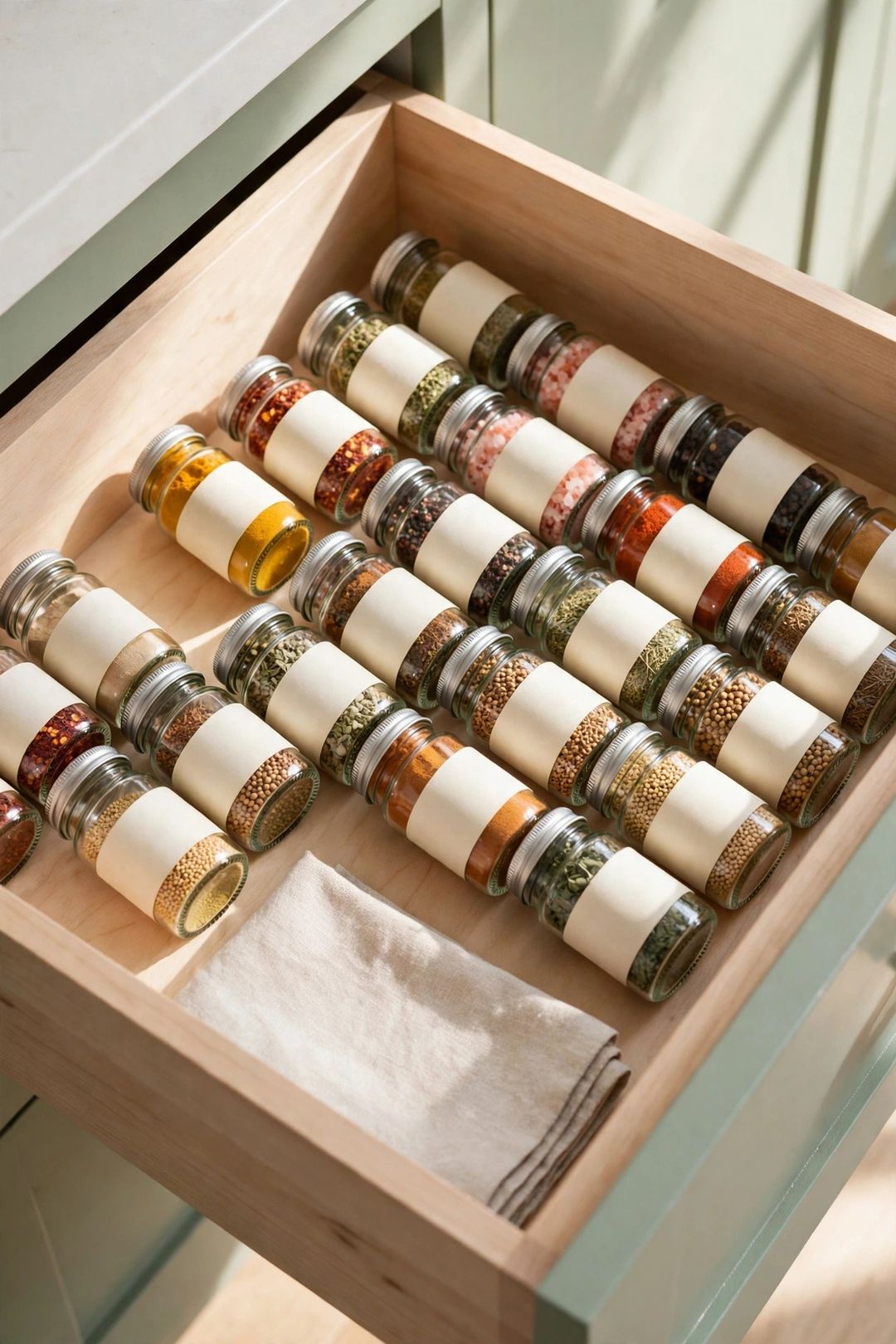
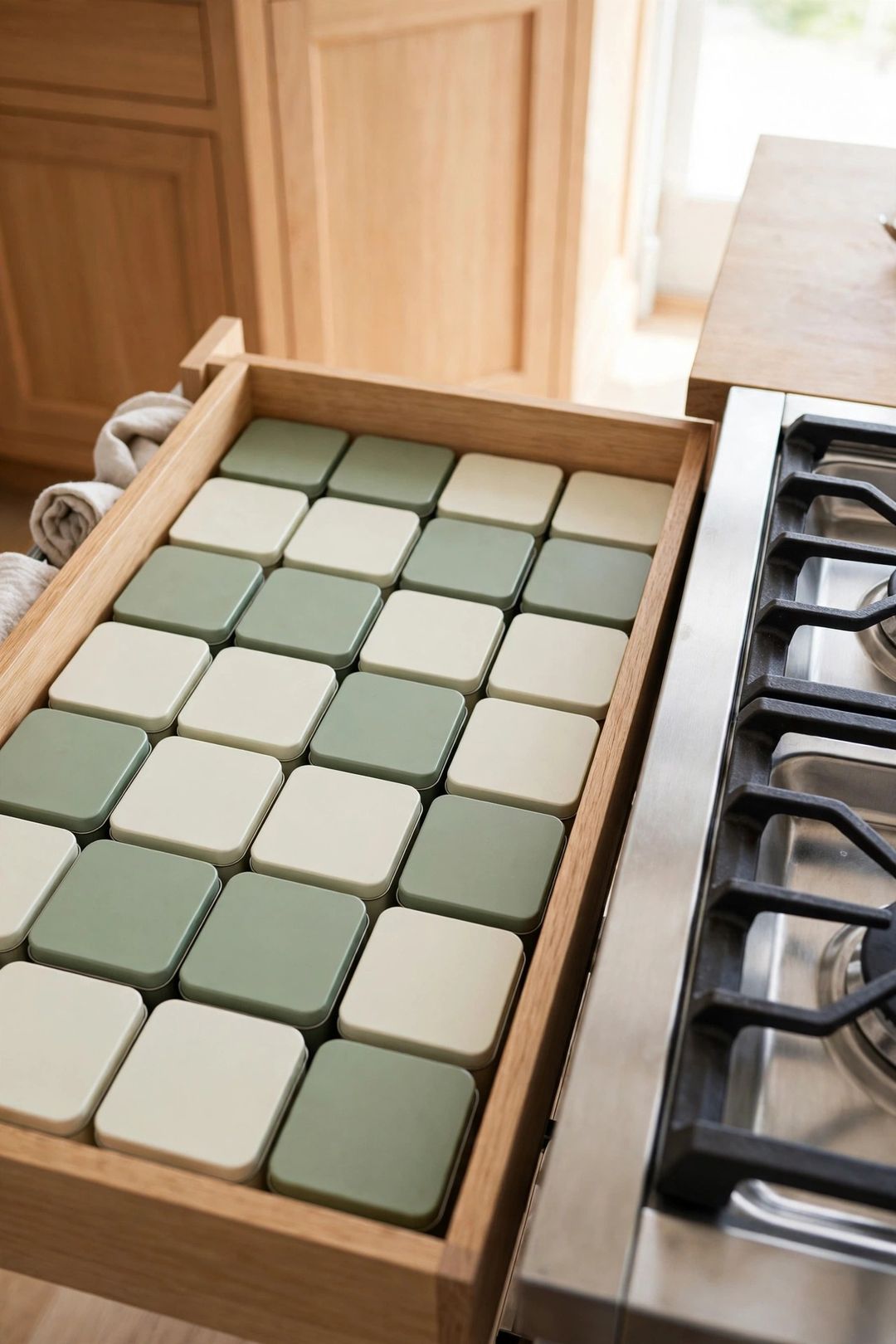
1. Choose uniform jars for a mixed collection. Matching 4-ounce jars line up with no wasted gaps. Square jars save the most space, sitting edge to edge. Round jars roll unless an insert holds them.
2. Keep original bottles if they already match. Bottles from one brand often share a height and lid size. Keeping them avoids cost and decanting work.
3. Decant the odd shapes. Tins, bags, and oversized bottles break the flat layout. Move them into the uniform size and store bulk backups in a cabinet.
4. Add shaker inserts where needed. Fine powders suit a shaker top. Leafy herbs are easier to pinch from an open jar.
Step 4: Tiered Insert vs. Flat Lay
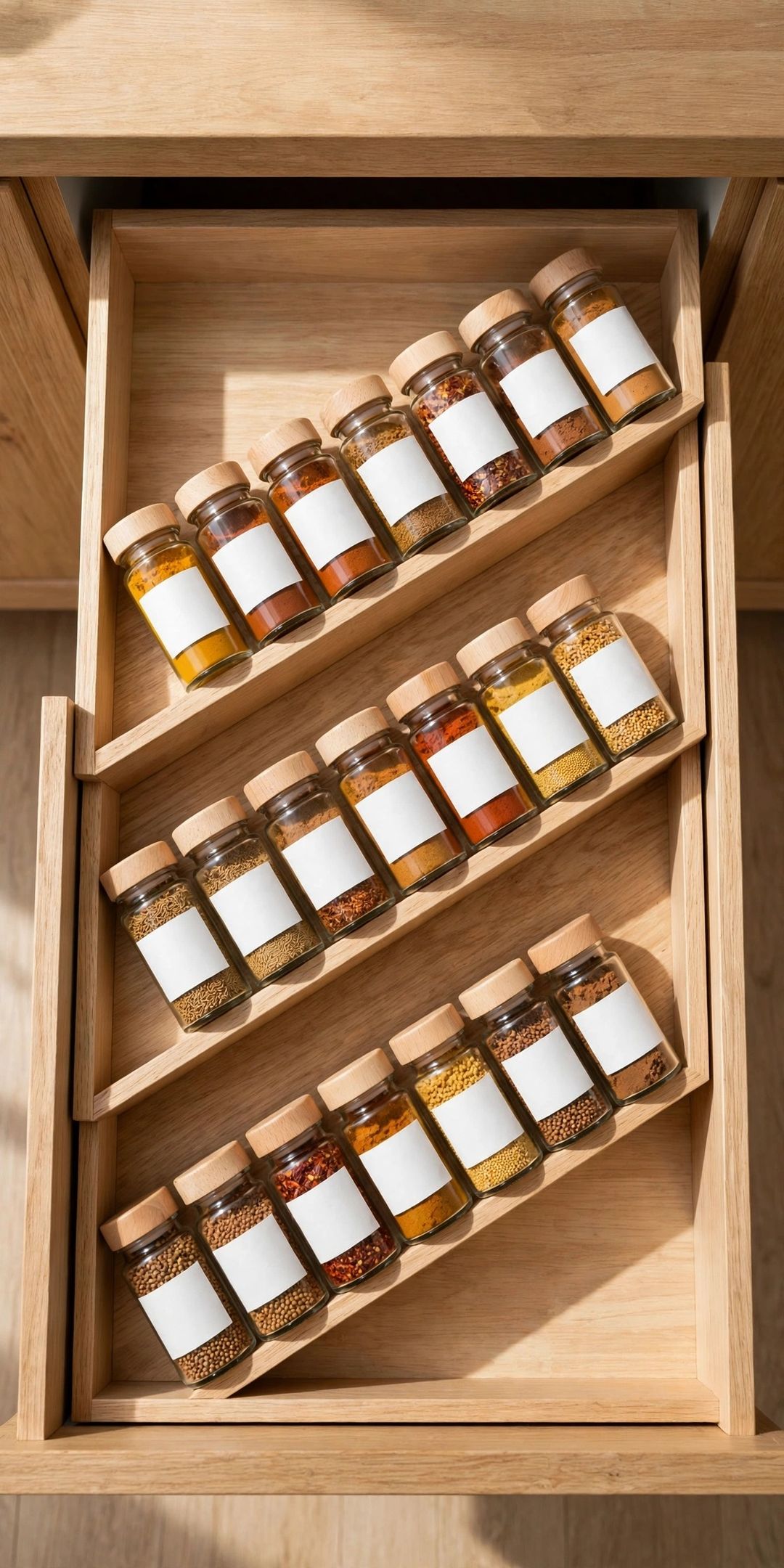
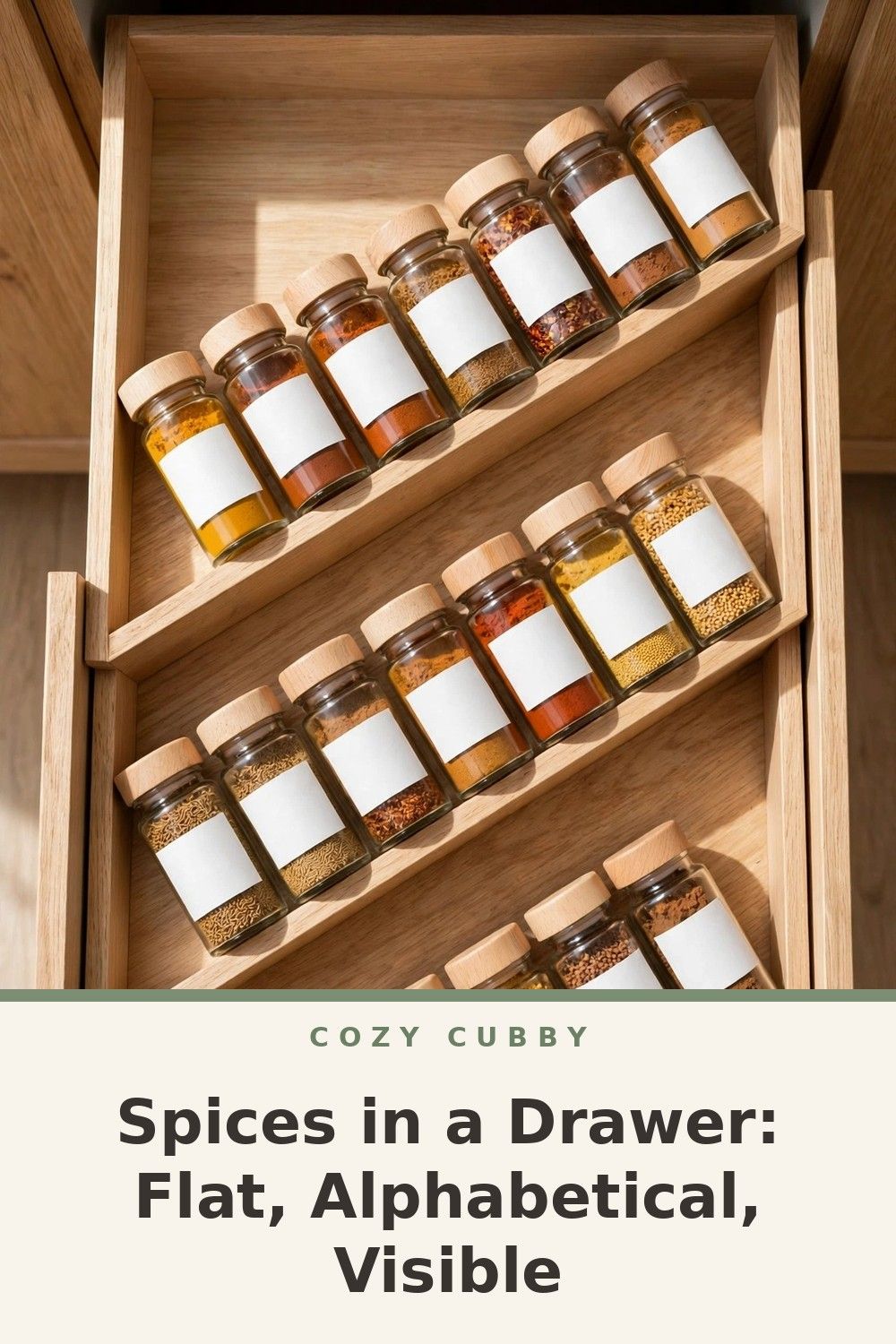
1. Use a tiered insert for deep drawers. An angled, stepped insert lifts back rows so jars rest at a tilt. Labels stay readable and jars do not slide. This suits drawers 4 inches deep or more.
2. Use a flat lay for shallow drawers. Jars lie on their sides in straight rows, labels up. Add a non-slip liner, sold in rolls you cut to size, so rows stay put.
3. Leave a finger gap. Rows packed too tight are hard to lift from. Leave about half an inch at the end of each row.
Step 5: Label the Tops, Not the Sides
In a drawer, the lid is the label space. Side labels face the wall and help no one.
1. Put the name on every lid. Use round top labels, a label maker, or a paint pen. Print large enough to read at arm's length.
2. Add the year on the bottom. A small date on the jar base makes the next freshness check fast.
3. Keep one label style. Mixed fonts and colors slow the eye. One color, one style, every jar.
Step 6: Alphabetical Order or By-Use Groups
1. Go alphabetical for larger collections. With 25 or more spices, alphabetical rows scan fastest and are easiest for anyone to put back correctly.
2. Group by use for smaller collections. Keep baking spices together, taco blends together, and salt, pepper, and garlic powder nearest the front.
3. Never mix the two systems. Half alphabetical and half grouped means nothing has a true home, and the drawer drifts back to random.
Step 7: The Refill and Decant Routine
1. Refill at the counter, not in the drawer. Use a small funnel over a tray. Loose dust makes flat jars slide and labels peel.
2. Wash before switching spices. A jar that held cumin should be washed and fully dry before it holds cinnamon, or flavors carry over.
3. Keep bulk backups out. Store refill bags and large bottles in a labeled cabinet bin. The drawer holds only the working set.
What to Buy
Uniform 4-ounce spice jars, typically $18–$32. Pro: Matching size makes flat rows work. Con: Decanting takes time. Skip if: Your bottles already match in height and lid size.
A tiered spice drawer insert, typically $15–$30. Pro: Angled rows keep labels visible in deep drawers. Con: Fixed tiers can waste space in narrow drawers. Skip if: Your drawer is under 4 inches deep.
A non-slip drawer liner roll, typically $8–$14. Pro: Cheap and cut to fit. Con: Texture traps spice dust. Skip if: You use a tiered insert.
Round top labels, typically $6–$12. Pro: Names face up where you read them. Con: Printed sets may miss rare blends. Skip if: A label maker already gives clear lid labels.
A small spice funnel, typically $5–$10. Pro: Wide mouth cuts refill spills. Con: One more tool to store. Skip if: Your jars have wide mouths.
Mistakes to Avoid
- Labeling the sides only. In a flat drawer, side labels face down. The lid is the only surface you see.
- Buying an insert before measuring. Inserts are sold by inside size. A half-inch error means it rocks or will not fit.
- Mixing jar heights in one row. Tall and short jars in the same row tip and roll. Keep one height per row.
- Storing bulk bags in the drawer. Bags break the flat grid and spill. The drawer is for the working set only.
- Skipping the freshness sort. Organizing faded spices just gives clutter a neater shape. Sort first.
Frequently Asked Questions
How many spice jars fit in a standard drawer?
A 4-ounce jar takes about 2 inches of row width, so a drawer with 18 usable inches holds roughly 8 to 9 jars per row.
Do spices go stale faster in a drawer?
No. A closed drawer is dark and away from stove heat. Heat, light, and steam do the most damage, so a drawer beats a rack above the stove.
What about spices in tins or bags?
Decant everyday tins and bags into the uniform jars. Keep the rest sealed in a labeled cabinet bin, since odd shapes do not sit flat.
Is alphabetical order worth it for a small collection?
Under about 15 spices, grouping by use is usually faster, with daily spices at the front. Alphabetical order earns its keep as the collection grows.
A flat drawer with labels on top turns seasoning into a one-glance job. Save this post to your Kitchen Organization board on Pinterest so the steps and sizes are handy on setup day.